

WashU Medicine physician-researchers at Siteman Cancer Center expand options for patients whose advanced melanoma has progressed despite previous immunotherapy
Immunotherapy has brought important advances to melanoma care, but treatment resistance remains a challenge for patients whose cancer continues to progress.
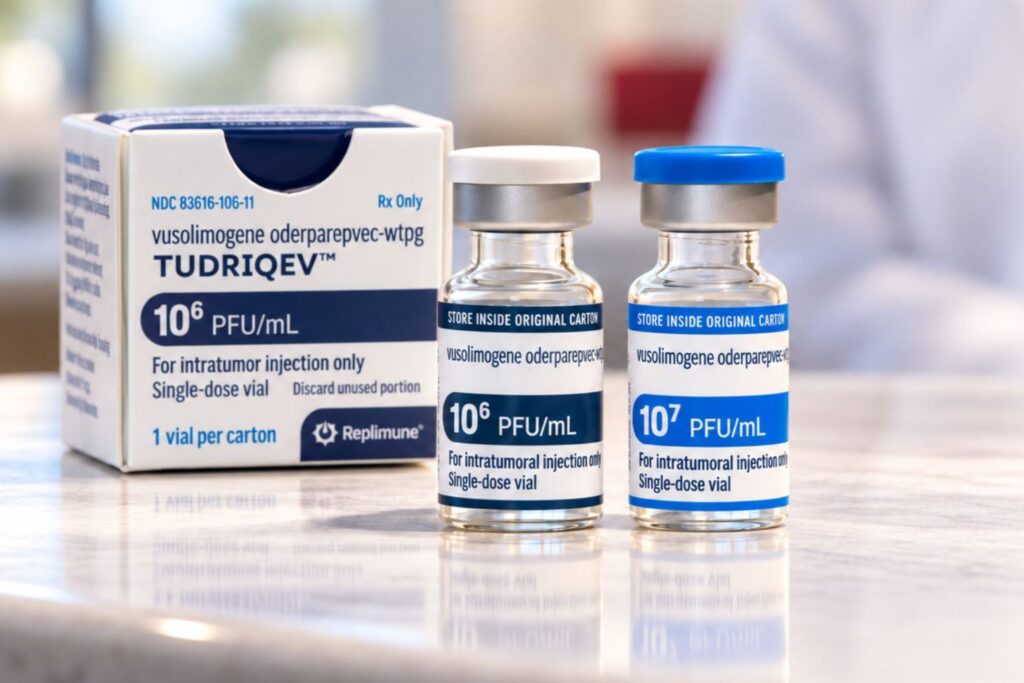
WashU Medicine physicians at Siteman Cancer Center are the first in the region to offer the newly FDA-approved treatment vusolimogene oderparepvec-wtpg, known commercially as Tudriqev. The therapy uses an engineered virus injected directly into melanoma tumors to destroy cancer cells and help stimulate an immune response. It is administered with nivolumab, an established immunotherapy.
For Aubriana McEvoy, MD, MS, FAAD, a WashU Medicine dermatologic surgeon at Siteman Cancer Center whose expertise includes melanoma and treatments delivered directly into tumors, the significance of Tudriqev lies in what it means for patients and the physicians caring for them.
“Treatments like Tudriqev expand the options we have to tailor care to each patient and their individual cancer,” she said. “One of the things I find most rewarding about being part of WashU Medicine and Siteman Cancer Center is bringing the latest scientific advances to our patients, with the goal of helping people with advanced and metastatic melanoma live longer and live well.”
When Viruses Join the Fight Against Melanoma
Viruses enter living cells and use them to reproduce. In a type of treatment called oncolytic viral therapy, scientists genetically modify viruses to preferentially multiply inside tumors and destroy cancer cells.
Tudriqev uses an engineered form of herpes simplex virus type 1. As infected melanoma cells die and break apart, they release fragments that help the immune system recognize the cancer.
Some melanoma cells can also escape immune attack by displaying a protein called PD-L1, which can suppress cancer-fighting T cells. Nivolumab, given intravenously, blocks PD-1 on T cells to help prevent this suppression. Together, the treatments aim to stimulate a broader immune response.
Understanding these challenges is closely connected to the work of David Chen, MD, PhD, a WashU Medicine dermatologist and physician-scientist at Siteman who treats patients with advanced skin cancers and studies how cancers develop and respond to treatment. Chen also serves on the National Comprehensive Cancer Network (NCCN) Guidelines for Melanoma: Cutaneous panel.
“Melanoma can escape the immune system, and overcoming treatment resistance remains one of our greatest challenges,” he said. “Immune-activating treatments directly injected into the tumor offer a promising approach to help the immune system recognize and respond to tumors that have previously resisted treatment.”
WashU Medicine has years of clinical and research experience with talimogene laherparepvec, or T-VEC, another oncolytic viral therapy sold as Imlygic. In a 2025 study published in the Journal for ImmunoTherapy of Cancer, Chen, along with fellow WashU Medicine researchers Melissa Yamada and George Ansstas, MD, collaborated with investigators at the University of Washington and Fred Hutchinson Cancer Center. Among 121 patients treated with T-VEC, including 69 at WashU Medicine, researchers documented meaningful and durable responses in some patients, even after previous therapies.
A September 2026 study published in The Journal of Clinical Investigation, led by Ansstas and Chen and co-authored by Lynn Cornelius, MD, also of WashU Medicine and Siteman, investigated combining T-VEC with binimetinib, a targeted drug, in patients whose melanoma carried a specific genetic mutation. Six of seven patients receiving the combination achieved complete responses.
Beyond the Injection Site: A Wider Immune Response
Although Tudriqev is injected directly into selected tumors, the immune response may reach much further. Once activated, cancer-fighting T cells can circulate through the bloodstream and recognize melanoma cells elsewhere in the body.
Clinical studies of Tudriqev combined with nivolumab documented tumor shrinkage in both injected and noninjected lesions, including tumors in internal organs.
Among the 91 patients included in the FDA’s efficacy analysis, approximately one in four (24.2%) experienced an objective response, meaning their cancer measurably shrank or disappeared. For those who responded, the median duration of response was 14.1 months.
These findings supported Tudriqev’s accelerated FDA approval in August 2026, with additional clinical research required to confirm its benefits.
One Team, Bringing Discoveries Closer to Patients
Bringing new melanoma treatments into clinical care draws on the multidisciplinary expertise of WashU Medicine physician-scientists and other researchers at Siteman Cancer Center — connecting dermatology, medical oncology, surgical oncology and cancer research.
Ansstas, a professor of medicine and director of the Melanoma Program at WashU Medicine, helps lead the multidisciplinary approach to melanoma care at Siteman Cancer Center.
“We are uniquely positioned at WashU Medicine to deliver truly patient-centered care, where all key stakeholders convene in the same room, in real time, to make the best possible decisions for our patients,” he said. “This collaborative environment allows us to translate clinical observations into scientific discoveries and develop novel therapeutic strategies, particularly for patients whose cancers have resisted existing treatments.”
For Cornelius, the Winfred and Emma Showman Professor of Dermatology and chief of the Division of Dermatology, introducing Tudriqev represents an important milestone in expanding advanced melanoma care at WashU Medicine.
“Being the first in the region to offer this therapy reflects the strength of our multidisciplinary team and our commitment to expanding treatment options for patients whose melanoma has resisted previous therapies,” she said.
Learn more