

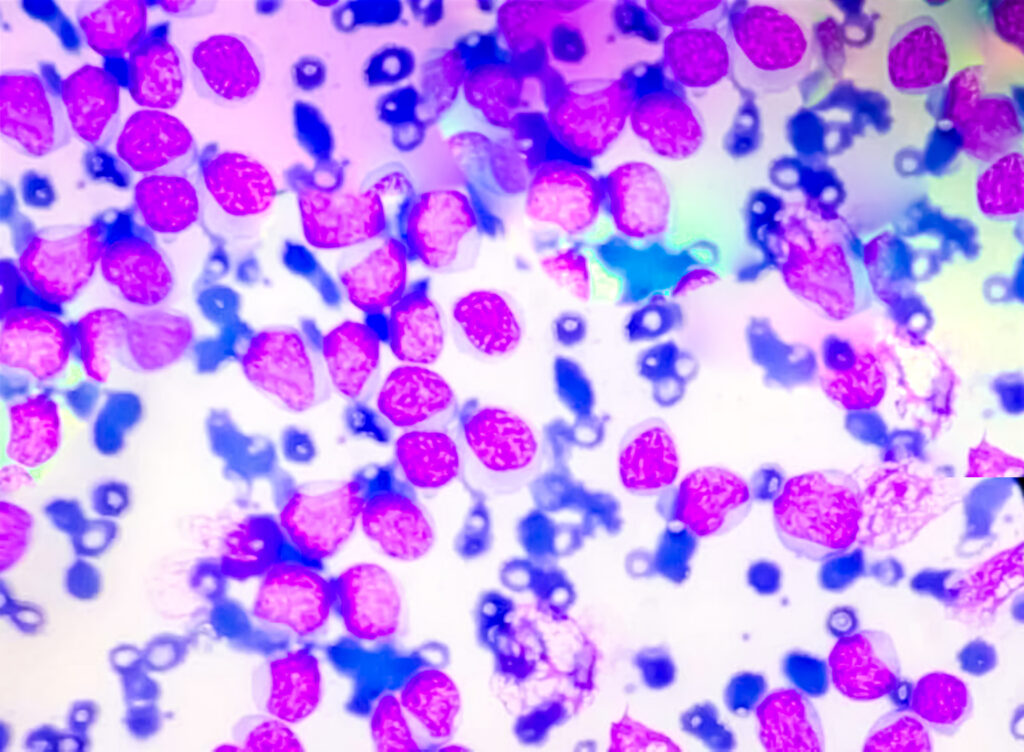
WashU Medicine physician-scientists at Siteman Cancer Center pioneer and validate a new method to determine which treatment option is most likely to improve patient outcomes
WashU Medicine researchers at Siteman Cancer Center, based at Barnes-Jewish Hospital and WashU Medicine, have found a way to determine which patients with intermediate-risk acute myeloid leukemia (AML) may do well with chemotherapy alone and which may benefit from an “upfront” stem-cell transplant early in their treatment course. The new approach, which tracks low-level residual cancer cells using personalized genetic testing, could help guide care for nearly half of people diagnosed with AML.
The pioneering research, published in NEJM Evidence, builds upon an initial study published by the same WashU Medicine team in The Journal of the American Medical Association in 2015, and provides clearer evidence on how to treat intermediate-risk AML patients.
AML is categorized into one of three risk groups based on recurrent genetic abnormalities at the time of diagnosis: favorable, adverse or intermediate-risk AML, explained WashU Medicine medical oncologist Meagan Jacoby, MD, PhD, first author of the new study. These risk groups do not account for the individual patient’s response to initial chemotherapy.
Favorable-risk patients typically respond well to chemotherapy alone, she said. Adverse-risk disease carries genetic features that make relapse likely, prompting an early referral for stem-cell transplant.
“In intermediate-risk AML, however, which occurs in nearly half of all cases diagnosed each year in the United States, the genetic profile at diagnosis alone does not always predict whether chemotherapy alone will be curative,” Jacoby said. “The leukemia may look cleared under the microscope after induction chemotherapy, but standard tests can miss residual disease or only detect specific mutations. We needed a better way to track measurable residual disease” — or MRD — “and determine the best treatment path for these intermediate-risk patients.”
To develop the guidance for intermediate-risk AML, Jacoby, along with co-author David Spencer, MD, PhD, senior author Timothy Ley, MD, and other WashU colleagues at Siteman Cancer Center, first used whole-exome sequencing to create a personalized list of leukemia-associated mutations. Then, one month after patients in the study received induction chemotherapy, the researchers used the same personalized list again to determine whether any of the mutations persisted.
Once they validated that whole-exome sequencing could accurately track the mutations before and after induction chemotherapy, the researchers then tracked how patients did with various treatment options.
Some intermediate-risk patients had cleared their leukemia‑associated mutations to extremely low levels. Others still had detectable leukemia-associated mutations despite normal-appearing bone marrow.
Patients who cleared their mutations were assigned to a treatment arm that used high‑dose chemotherapy to “consolidate” their treatment. These patients had outcomes similar to that of favorable-risk disease, with a two‑year overall survival of nearly 80%. Even when relapse occurred, most were successfully treated with transplant later.
For patients whose mutations persisted, however, the outcomes were markedly different. Those who went straight to transplant did exceptionally well. Most patients who did not have a transplant relapsed quickly and had a median survival of 18 months.
“Mutation clearance identified patients who could safely receive chemotherapy consolidation,” Spencer said. “Persistent mutations were a strong signal that transplant in first remission was the right choice.”
The new method — first creating the leukemia mutation list using whole-exome sequencing and then proving it can guide treatment — “repositions personalized molecular MRD beyond prognostic observation towards therapeutic decision‑making,” according to an accompanying editorial in NEJM Evidence.
The next step is for researchers to conduct randomized, multicenter clinical trials to further validate the method and update clinical guidelines.
“With nearly 23,000 people diagnosed with AML in the U.S. each year — and more than 10,000 falling into the intermediate‑risk category — the personalized whole-exome sequencing MRD approach developed here at WashU could become a new guidepost for post‑remission therapy for intermediate-risk AML patients,” Jacoby said.