

Participants in early clinical trial had increased immune response, slowed tumor progression
A personalized vaccine to treat glioblastoma, a fast-growing and incurable brain cancer that affects four in 100,000 people in the U.S., is safe and elicits robust and broad immune responses that appears to increase recurrence-free survival in a subset of patients after surgery, according to an early-stage clinical trial co-led by researchers at Washington University School of Medicine in St. Louis.
In patients with an especially aggressive form of glioblastoma, the vaccine caused no serious side effects and prolonged patients’ overall survival compared to historical outcomes after standard-of-care surgery and chemo-radiotherapy. One long-term survivor remains recurrence-free nearly five years later.
The results of the phase 1 trial, conducted at Siteman Cancer Center, based at Barnes-Jewish Hospital and WashU Medicine, were published May 12 in Nature Cancer. The study was led jointly by Mass General Brigham and Geneos Therapeutics, a Philadelphia-based biotechnology company.
“We are extremely encouraged by these results,” said Tanner M. Johanns, MD, PhD, lead author of the study and an assistant professor in the Division of Oncology in the John T. Milliken Department of Medicine at WashU Medicine. “This kind of vaccine is a first for glioblastoma, and it is exciting to think how we can leverage this individualized therapeutic DNA cancer vaccine platform to make a positive impact on the lives of patients who are fighting this disease. Additionally, combination therapies leveraging this personalized platform are currently being investigated at WashU to test if outcomes may be improved further.”
The novel treatment uses engineered DNA molecules designed to stimulate the patient’s immune system against the cancer. Each patient’s tumor has unique proteins specific to that tumor, and this vaccine activates the patient’s immune system to recognize those proteins and eliminate the tumor cells.
Johanns said that although some immunotherapies targeting glioblastoma have shown promise in previous studies, they ultimately are ineffective in significantly delaying or preventing recurrence. That’s likely because glioblastoma can evolve and escape immune attack, but Johanns’ vaccine was designed to help the immune system recognize many different targets on cancer cells. So even if the tumor loses several of these targets, the vaccine is still able to generate responses to many others.
Additionally, glioblastoma is termed a “cold” tumor, meaning that the tumor environment is able to hide from the immune system. The cancer vaccine that was used in this trial, developed by Geneos Therapeutics, transforms cold tumors into “hot” tumors that are then susceptible to immune-mediated eradication. The vaccine is thus able to improve the patient’s immune response by targeting proteins on the cancer cell and by making the environment within the tumor more favorable to immune activation.
“We chose a DNA-based platform because it would allow us an opportunity to target more cancer proteins than any vaccine had targeted before,” said Johanns, who treats patients at Siteman and is a research member there. “Our thinking was that if we could generate a broader range of immune responses against those proteins then it may lead to a more potent vaccine compared to other vaccine platforms with more limited protein targets.”
This DNA-based vaccine platform was able to activate each patient’s immune system to seek out as many as 40 cancer proteins specific to each patient’s tumor — twice as many as had been targeted by any cancer vaccine therapy to date.
More Targets, More Chances for Success
The vaccine in the study, called GNOS-PV01, targets so-called neoantigens — proteins unique to an individual patient’s cancer cells that their immune cells can recognize. The neoantigens were identified and selected using an algorithm developed at WashU Medicine by computational biologists and co-authors Obi Griffith, PhD, a professor of medicine, and Malachi Griffith, PhD, an associate professor of medicine, both in the Division of Oncology and research members at Siteman. Johanns and his colleagues selected neoantigens from different regions of a patient’s tumor, a method they incorporated to further increase the number of cancer cell proteins targeted by the vaccine.
A vaccine platform using a different DNA-based technology developed for breast cancer by co-author William Gillanders, MD, the Mary Culver Distinguished Professor of Surgery at WashU Medicine who treats patients at Siteman, inspired the idea to bring Geneos’ GNOS-PV01 vaccine to WashU Medicine for use against glioblastoma, Johanns said.
The trial enrolled nine adult patients who had been recently diagnosed with glioblastoma. All patients were treated at Siteman Cancer Center. The team prepared a synthetic DNA molecule encoding the unique information for each patient’s tumor neoantigens. The vaccine was manufactured at the Biologic Therapy Core Facility at Siteman during the patient’s post-operative recovery and subsequent radiation treatment.
The vaccine injections started, on average, 10 weeks after the patient’s surgery and were administered every three weeks for a nine-week period, and then every nine weeks thereafter as long as patients were able to participate. All participants, except one who was taking an immune-suppressing steroid, showed an increase in immune-cell activity indicating a response to the vaccine intervention.
Two-thirds of the patients had no progression of their cancer six months out from their surgeries, and two-thirds survived one year. Typically, around 40% of glioblastoma patients reach either milestone.
One-third of the participants were still alive after two years, which is twice the historical survival rate for this patient population. One participant is still alive and recurrence-free today, almost five years after her initial diagnosis.
An Investment in the Future
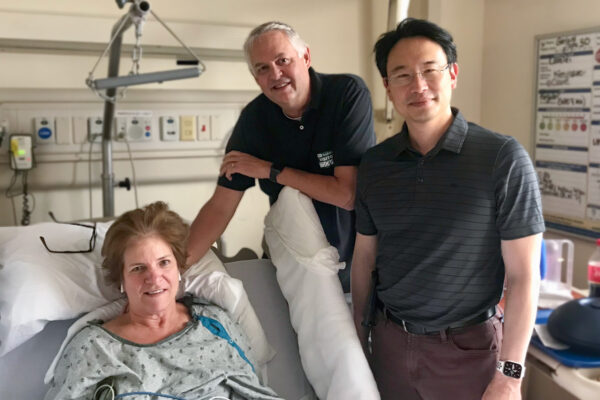
A WashU Medicine-led clinical trial conducted at Siteman Cancer Center has found that a personalized vaccine to treat glioblastoma appears to increase recurrence-free survival in a subset of patients after surgery. Trial participant Kim Garland (left) has had no recurrence of her tumor in the nearly five years since her surgery, which was performed by Albert Kim, MD, PhD (right), the August A. Busch, Jr. Professor of Neurological Surgery at WashU Medicine. Kim’s husband Scott Garland pictured in middle.
Kim Garland is a retired school nurse who lives in Kirkwood, Missouri, with Scott, her husband of 31 years. In June 2021, at age 62, Kim was volunteering at a youth camp in Ironton, Missouri, when her daughter-in-law, also volunteering at the same camp, noticed that Kim was struggling with confusion and forgetfulness, as well as headaches that would come and go throughout the day.
“I was forgetting things, things that should have been very obvious,” said Kim.
A scan at a local hospital’s emergency room back in St. Louis revealed a 6.5-centimeter mass in Kim’s brain — about the size of a small avocado. Within the week, Albert Kim, MD, PhD, the August A. Busch, Jr. Professor of Neurological Surgery at WashU Medicine, director of The Brain Tumor Center at Siteman, and co-author of the study, performed the initial surgery to remove her tumor. The grim diagnosis of grade 4 glioblastoma came after the tumor was removed.
When offered the opportunity to participate in a clinical trial, Kim Garland agreed in hopes that her participation would improve future treatments. After receiving this prognosis, both Kim and Scott did not expect that she would be alive with no recurrence nearly five years after her initial diagnosis.
“We know we are fortunate to have the kind of care that Kim has been able to receive, just a 30-minute drive from our home,” Scott said. “We see many other patients who are traveling long distances for their treatments. Having this level of care and treatment so close to home has been a huge blessing.”
With the support of their team, the couple have gained the confidence to make longer-term plans, including a long-delayed vacation this summer and spending quality time with their children and 15 grandchildren — a big change from the week-by-week life they were living in the aftermath of Kim’s initial diagnosis.
“Cancer vaccines have a long history, and the development of personalized neoantigen-targeting therapeutic vaccines now represents a highly compelling approach in glioblastoma and in other cancers,” said co-senior author Gavin Dunn, MD, PhD, a neurosurgical oncologist at Mass General Brigham Cancer Institute. “These programs require a high degree of integrated teamwork, and we are fortunate to have collaborated with many dedicated team members in this effort.”
Kim Garland’s cancer, along with those of the other patients in the trial, was an unmethylated MGMT subtype of glioblastoma, which is particularly hard to treat because it is not responsive to available treatment options such as chemotherapy. Johanns said the next step is to assess the vaccine’s efficacy in a larger group of patients, and to expand the treatment to all types of glioblastomas. The goal of Johanns and his team is to improve the vaccine response to ensure that more patients can experience benefits like those experienced by Kim Garland.
The knowledge that their participation in the trial has potentially advanced care is a comfort to the Garlands, who still need to steel themselves before each follow-up appointment, out of concern that Kim’s tumor could yet return.
“What we’re hopeful for is that through research like this, someday, when another person hears the words ‘you have glioblastoma’ as their diagnosis, it will not cause as much anxiety,” said Scott. “Maybe, they will be told ‘this is the cancer you have, but it is very treatable.’ We are fortunate and blessed to be at the right place and at the right time, to be part of this clinical trial and have a small part in the battle against this terrible disease.”
# # #
Garfinkle EAR, Perales-Linares R, Gimple RC, Livingstone AJ, Kaleigh F. Roberts KF, Butt OH, Goedegebuure. SP, McLellan MD, Chang GS, Hundal J, Yan J, Navarro JB, Paxton SA, Chattopadhyay S, Cooch N, Perales-Puchalt A, Stavroulaki K, Rochestie S, Peters J, Junker B, Campian JL, Chheda MG, Chicoine MR, Kim AH, Willie JT, Zipfel GJ, Dowling JL, Miller CA, Griffith OL, Griffith M, Gillanders WE, Miller, KE, Mardis ER, Sardesai NY, Dunn GP, Johanns TM. Adjuvant personalized multivalent neoantigen DNA vaccination induces tumor-specific immune responses in newly diagnosed glioblastoma patients. Nature Cancer. May 12, 2026. DOI: 10.1038/s43018-026-01163-w
Funding for this study came from the Mark Foundation for Cancer Research Momentum Fellowship, National Institutes of Health (NIH) National Institute of Neurological Disorders and Stroke (NINDS) grants R01NS117149 and R01 NS107833, the Nationwide Foundation Pediatric Innovation Fund, NIH K12CA167540 and The Alvin J. Siteman Cancer Center Investment Program along with The Foundation for Barnes-Jewish Hospital, NIH NINDS R01NS112712 and The Schnuck Family Fund and The Knight and Christopher Davidson Family Fund. Additional study support for development, manufacture, and administration of the treatment and monitoring of the immune responses was provided by Geneos Therapeutics. The content is solely the responsibility of the authors and does not necessarily represent the official views of the NIH.
R.P.L., J.Y., N.C., A.P.P., S.R., J.P., and N.Y.S are either current or previous Geneos Therapeutics employees.