

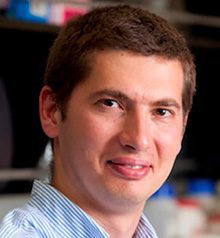

Maxim Artyomov, PhD

Academic Department Pathology and Immunology
Research Program Tumor Immunology
Maxim Artyomov

Researcher Background

Primary Academic Title

Professor of Pathology and Immunology, Division of Immunobiology, WashU Medicine

Training

  • 2009 - 2012: Postdoctoral Fellow, Broad Institute of MIT & Harvard, Cambridge, MA

Education

  • 2009: PhD, Massachusetts Institute of Technology

Research & Select Publications

Research Interest

Systems immunology using cross-disciplinary approaches to data generation and analysis; novel fundamental biology in immunometabolism, cancer immunology and aging; single-cell RNA-sequencing, transcriptional data analysis, chip-sequencing, metabolomics, data integration, peptide-MHC binding

Research Publications

Non-negative matrix factorization and deconvolution as a dual simplex problem.
Authors:

Kleverov D, Aladyeva E, Serdyukov A, Artyomov MN

Journal & Year:

Genome Biol • 2026

Accurate chromatin marks peak calling with Omnipeak.
Authors:

Shpynov O, Artyomov MN

Journal & Year:

Nucleic Acids Res • 2026

Human immune aging.
Authors:

Terekhova M, Bohacova P, Artyomov MN

Journal & Year:

Immunity • 2025

Inflammaging in aged tissues drives remodeling of the CD8 + T cell compartment.
Authors:

Shchukina I, Rodriguez-Hernandez CJ, Ruiz HS, one or more additional authors omitted Artyomov MN

Journal & Year:

bioRxiv • 2025

CORESH: a gene signature-based search engine for public gene expression datasets.
Authors:

Sukhov V, Nugmanova A, Vorontsov Y, one or more additional authors omitted Artyomov M, Sergushichev A

Journal & Year:

Nucleic Acids Res • 2025

Multi-omic and spatial analysis of mouse kidneys highlights sex-specific differences in gene regulation across the lifespan.
Authors:

Chen S, Liu R, Mo CK, one or more additional authors omitted Artyomov MN, one or more additional authors omitted Chen F

Journal & Year:

Nat Genet • 2025

Multidimensional profiling of human T cells reveals high CD38 expression, marking recent thymic emigrants and age-related naive T cell remodeling.
Authors:

Bohacova P, Terekhova M, Tsurinov P, one or more additional authors omitted Artyomov MN

Journal & Year:

Immunity • 2024

ZBTB46 coordinates angiogenesis and immunity to control tumor outcome.
Authors:

Kabir AU, Zeng C, Subramanian M, one or more additional authors omitted Artyomov MN, Choi K

Journal & Year:

Nat Immunol • 2024

Neoantigen-specific cytotoxic Tr1 CD4 T cells suppress cancer immunotherapy.
Authors:

Sultan H, Takeuchi Y, Ward JP, one or more additional authors omitted Artyomov MN, Schreiber RD

Journal & Year:

Nature • 2024

Inherited C-terminal TREX1 variants disrupt homology-directed repair to cause senescence and DNA damage phenotypes in Drosophila, mice, and humans.
Authors:

Chauvin SD, Ando S, Holley JA, one or more additional authors omitted Artyomov MN, one or more additional authors omitted Miner JJ

Journal & Year:

Nat Commun • 2024

Rapid unleashing of macrophage efferocytic capacity via transcriptional pause release.
Authors:

Tufan T, Comertpay G, Villani A, one or more additional authors omitted Artyomov MN, one or more additional authors omitted Ravichandran KS

Journal & Year:

Nature • 2024

Public platform with 39,472 exome control samples enables association studies without genotype sharing.
Authors:

Artomov M, Loboda AA, Artyomov MN, Daly MJ

Journal & Year:

Nat Genet • 2024

Single-cell atlas of healthy human blood unveils age-related loss of NKG2C+GZMB-CD8+ memory T cells and accumulation of type 2 memory T cells.
Authors:

Terekhova M, Swain A, Bohacova P, one or more additional authors omitted Artyomov MN

Journal & Year:

Immunity • 2023

T cell control of inflammaging.
Authors:

Shchukina I, Bohacova P, Artyomov MN

Journal & Year:

Semin Immunol • 2023