


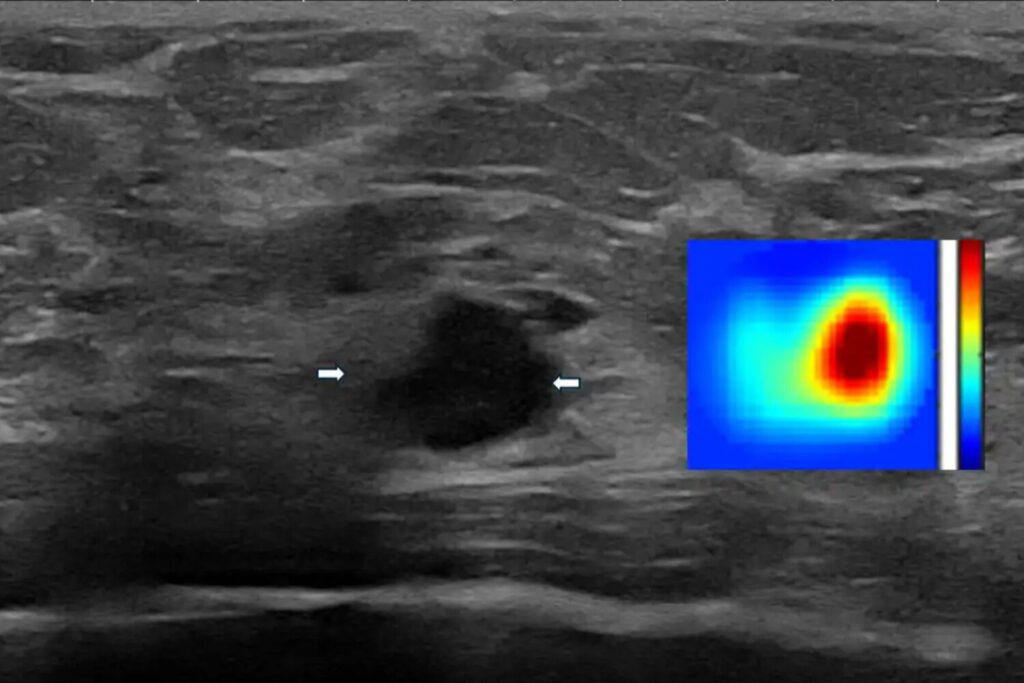
WashU researchers at Siteman Cancer Center are advancing breast imaging to help patients avoid invasive procedures and improve the screening experience
In a new discovery at Siteman Cancer Center at Barnes-Jewish Hospital and WashU Medicine, a team of researchers and physicians found that utilizing ultrasound-guided diffuse optical tomography technology can reduce unnecessary breast biopsy rates by nearly 25%.
Now for the first time in a clinical trial, Siteman Cancer Center is using these new methods first, rather than starting with a biopsy, to determine if additional diagnoses are needed to test for cancer. The research was recently published in Breast Cancer Research and supported by a nearly $2 million grant from the National Cancer Institute of the National Institutes of Health.
Every year in the United States, more than 1 million breast biopsies are performed. Yet 75-80% of those biopsies turn out to be benign, meaning patients undergo an invasive procedure, anxiety, and waiting — only to learn cancer is not present.
New Research in Breast Cancer Imaging
In a double-blind clinical trial involving 226 patients, the WashU Medicine research and physician team at Siteman found that ultrasound-guided diffuse optical tomography (DOT) — used alongside standard breast ultrasound — can reduce unnecessary benign biopsies by nearly 25%, while maintaining a false negative rate below 2%, consistent with American College of Radiology safety standards.
By combining standard ultrasound with diffuse optical tomography, radiologists gain additional information about tissue biology, not just structure.
Why This Matters for Patients Undergoing Breast Imaging
A biopsy remains the only way to definitively diagnose breast cancer. However, many suspicious findings on mammography or ultrasound are not cancer — and the uncertainty between imaging and biopsy can be one of the most stressful periods in a patient’s experience.
This research aims to improve how physicians distinguish which lesions truly require biopsy and which may be safely monitored. For patients, it means care that is not only the most advanced but thoughtfully designed to ensure that cancer is detected as early and screening is as accessible and low-cost as possible for more people.
Leadership in Breast Imaging Innovation
The study was led by:
- Quing Zhu, PhD, Edwin H. Murty Professor of Engineering, WashU McKelvey School of Engineering
- Debbie Bennett, MD, Ronald and Hanna Evens Professor of Women’s Health, WashU Medicine and Chief of Breast Imaging at Mallinckrodt Institute of Radiology
Their multidisciplinary team included experts in radiology, pathology, engineering and clinical research across Siteman and WashU:
- Ian Hagemann, MD, PhD, a pathologist at Siteman and professor of pathology
- Jaimee Mannix, MD, a radiologist at Siteman and assistant professor of radiology
- Kimberly Wiele, MD, a radiologist at Siteman and professor of radiology
- Megan Luther, a clinical research coordinator
- Jingqin (Rosy) Luo, PhD, a Siteman research member and professor of surgery
The study team also included Steven P. Poplack, MD, formerly of WashU Medicine and Siteman, who is now a professor of radiology (breast imaging) at Stanford University.
# # #
Zhu Q, Bennett D, Hagemann IS, Mannix J, Wiele K, Luther M, Luo J, Poplack SP. Ultrasound-guided diffuse optical tomography: An adjunct to ultrasound that can reduce unnecessary breast biopsies. Breast Cancer Research, published online Dec. 31, 2025. DOI: https://doi.org/10.1186/s13058-025-02206-3
Funding for this research was provided by the National Cancer Institute of the National Institutes of Health (R01CA228047).