The award, presented by the American Statistical Association, recognizes early-career statistical innovators with a tenacious and resolute commitment to excellence. Recipients have represented a variety of disciplines.
Jiang, an associate professor of surgery in the Division of Public Health Sciences at WashU Medicine, is the co-developer of technology that harnesses artificial intelligence (AI) to analyze mammograms and improve the accuracy of predicting a woman’s personalized five-year risk of developing breast cancer. Last year, the software received Breakthrough Device designation from the Food and Drug Administration (FDA) and was acquired by Lunit, a leading company in developing AI-based technologies for cancer prevention and early detection.
The award was named in honor of pathbreaking Black female statistician Annie T. Randall for her pioneering career in government amid pervasive racial discrimination.
Jiang will be recognized at the 2026 Joint Statistical Meetings, the biggest conference for statisticians and data scientists globally, Aug. 1-6 in Boston.
Strategy seeks to expand immunotherapies for leukemia, other malignancies
For highly aggressive types of blood cancer, stem cell transplantation is often the only potentially curative therapy, yet even after a transplant, these cancers often return.
Now, a clinical trial, led by researchers at Washington University School of Medicine in St. Louis, shows that a stem cell transplant in which the donor cells have been genetically engineered to remove a particular protein helps prevent toxic side effects and potentially improves the effectiveness of therapies given after a transplant to help prevent cancer recurrence.
The study was conducted at Siteman Cancer Center, based at Barnes-Jewish Hospital and WashU Medicine, and 14 other sites in the U.S. and Canada. The findings are published May 12 in the journal Nature Medicine.
According to the study’s corresponding author, John F. DiPersio, MD, PhD, the Virginia E. & Sam J. Golman Professor of Medicine at WashU Medicine, this gene-editing technology could help address a longstanding frustration in the field: CAR-T cell therapy — an immunotherapy that effectively treats some aggressive blood cancers — has not worked against all blood cancers, including acute myeloid leukemia (AML) and myelodysplastic syndrome (MDS).
According to DiPersio, who treats patients at Siteman and is a research member there, myeloid cancers like AML and MDS are tricky to treat with CAR-T cells because the same proteins on cancer cells that the immunotherapy homes in on for destruction are also present on healthy myeloid cells, including therapeutic donor stem cells. As such, the anti-cancer therapy carries a high risk of toxicity because it also destroys healthy blood stem cells, which can trigger a dangerous inflammatory cascade. This effect also could dilute the effect of the anti-cancer therapy because so many of the CAR-T cells are attacking the wrong targets, leaving many cancer cells untouched.
This basic concept was first described by Miriam Y. Kim, MD, now an assistant professor of medicine at WashU Medicine. She began this research as a postdoctoral researcher at the University of Pennsylvania and continued the work in the DiPersio lab before becoming an independent investigator in the WashU Medicine Division of Oncology. She treats patients at Siteman and is also a research member there.
For this clinical trial, patients with AML and MDS received donor stem cells that had a target protein, called CD33, removed, in hopes that immunotherapy targeted against CD33 would kill the cancer and ignore the healthy cells.
“We are encouraged by the results of this study showing that a CD33-deleted stem cell transplant looks very similar to the outcomes of standard stem cell transplantation,” said DiPersio, who also directs WashU Medicine’s Center for Gene and Cellular Immunotherapy. “In the future, we are hopeful we will be able to combine this with CD33-targeted immunotherapies, such as CAR-T cells, and improve treatment options for patients with these very aggressive blood cancers.”
To that end, DiPersio and his collaborators have also published a single case study of a patient with high-risk AML who received a CD33-deleted stem cell transplant and later, upon relapse after the transplant, received a CD33-targeted CAR-T cell therapy, which used T cells from the same donor who provided the stem cell transplant. The patient — who had one of the most aggressive types of AML — achieved complete remission and remains cancer free over one year after receiving the CAR-T cell therapy. The patient also had normal blood cell production return with all blood cells lacking CD33, providing evidence that the genetically engineered donor cells had established themselves in the bone marrow. DiPersio is the senior author of this study, published in October 2025 in JCO Precision Oncology.
Shielding Healthy Cells
CD33 is an appealing protein to delete from donor stem cells because it is only present on blood-forming cells and not in other tissues, and because there is evidence it is not required for the proper function of blood stem cells, given that individuals born without CD33 have no apparent health problems. After a patient has successfully received this type of stem cell transplant, any remaining cells in the body with CD33 on the surface should, in theory, only be the cancer. Then, CAR-T cells or another immunotherapy designed to target CD33 would kill only the cancer cells and leave healthy donor stem cells untouched.
In this phase 1/2 multicenter clinical trial, 30 adult patients with AML or MDS at high risk of relapse received a stem cell transplant in which CD33 had been removed from the donor cells using CRISPR gene editing technology before the transplant procedure. The CD33-deleted stem cell product is called tremtelectogene empogeditemcel (trem-cel) and was made by Vor Biopharma, which funded the study.
As proof of concept, the patients also received a maintenance therapy that targets CD33, after they underwent the stem cell transplant. While not a CD33-targeted CAR-T cell, the maintenance therapy, called gemtuzumab ozogamicin, is a type of engineered antibody that targets CD33 and carries an anti-cancer drug. Gemtuzumab ozogamicin is approved by the Food and Drug Administration to treat CD33-positive AML and is in clinical trials for CD33-positive MDS. While it helps prevent relapse, the drug’s use is limited because it can cause liver toxicity and damage to blood cells, including dangerously low counts of white blood cells, red blood cells and platelets.
All patients achieved engraftment of their transplanted stem cells by day 28, meaning the cells had gathered in the bone marrow and started working. Some patients met this goal sooner, and platelet production returned by day 16, on average. These timeframes are comparable to those of standard transplanted stem cells.
Average survival was just over 14 months. Nineteen patients received at least one cycle of the antibody maintenance therapy as part of a dose-escalation protocol, and the researchers were able to establish the recommended dose. The researchers found that patients maintained blood cell counts across all doses, suggesting that the gene-edited stem cell transplant protected patients from the dangerously low blood cell counts typically seen during this maintenance therapy following a standard stem cell transplant.
Side effects during the treatment were similar to those of standard transplants, including anemia, low platelets, fever, infections and graft-versus-host disease, in which the donor cells attack the patient’s healthy tissues. Seven patients died during the study, with four due to the cancer progressing and three due to transplant-related causes, including kidney failure, liver toxicity and sepsis.
DiPersio said the results of the study lay the groundwork for developing paired CD33-deleted stem cell transplant and CD33-targeted immunotherapy interventions that avoid destruction of healthy donor cells in the course of cancer treatment.
# # #
DiPersio JF, Koehne G, Shah NN, Bernard L, Suh HC, Koura D, Tamari R, Mushtaq MU, Maakaron J, Rimando J, Kennedy VE, Patel SS, Hudson C, Loken M, Stanizzi DA, Lee-Sundlov MM, Thosar S, Mundelboim G, Guo G, Ge HG, Li BE, Xavier-Ferrucio J, Hyzy SL, Lin MI, Raffel GD, Cooper BW. Phase 1/2 trial of trem-cel CD33-deleted allogeneic hematopoietic cell transplantation with gemtuzumab ozogamicin maintenance in adult high-risk AML. Nature Medicine. May 12, 2026. DOI: 10.1038/s41591-026-04362-1.
This work was supported by Vor Biopharma. Several co-authors were employees of the company when the work was conducted.
Participants in early clinical trial had increased immune response, slowed tumor progression
A personalized vaccine to treat glioblastoma, a fast-growing and incurable brain cancer that affects four in 100,000 people in the U.S., is safe and elicits robust and broad immune responses that appears to increase recurrence-free survival in a subset of patients after surgery, according to an early-stage clinical trial co-led by researchers at Washington University School of Medicine in St. Louis.
In patients with an especially aggressive form of glioblastoma, the vaccine caused no serious side effects and prolonged patients’ overall survival compared to historical outcomes after standard-of-care surgery and chemo-radiotherapy. One long-term survivor remains recurrence-free nearly five years later.
The results of the phase 1 trial, conducted at Siteman Cancer Center, based at Barnes-Jewish Hospital and WashU Medicine, were published May 12 in Nature Cancer. The study was led jointly by Mass General Brigham and Geneos Therapeutics, a Philadelphia-based biotechnology company.
“We are extremely encouraged by these results,” said Tanner M. Johanns, MD, PhD, lead author of the study and an assistant professor in the Division of Oncology in the John T. Milliken Department of Medicine at WashU Medicine. “This kind of vaccine is a first for glioblastoma, and it is exciting to think how we can leverage this individualized therapeutic DNA cancer vaccine platform to make a positive impact on the lives of patients who are fighting this disease. Additionally, combination therapies leveraging this personalized platform are currently being investigated at WashU to test if outcomes may be improved further.”
The novel treatment uses engineered DNA molecules designed to stimulate the patient’s immune system against the cancer. Each patient’s tumor has unique proteins specific to that tumor, and this vaccine activates the patient’s immune system to recognize those proteins and eliminate the tumor cells.
Johanns said that although some immunotherapies targeting glioblastoma have shown promise in previous studies, they ultimately are ineffective in significantly delaying or preventing recurrence. That’s likely because glioblastoma can evolve and escape immune attack, but Johanns’ vaccine was designed to help the immune system recognize many different targets on cancer cells. So even if the tumor loses several of these targets, the vaccine is still able to generate responses to many others.
Additionally, glioblastoma is termed a “cold” tumor, meaning that the tumor environment is able to hide from the immune system. The cancer vaccine that was used in this trial, developed by Geneos Therapeutics, transforms cold tumors into “hot” tumors that are then susceptible to immune-mediated eradication. The vaccine is thus able to improve the patient’s immune response by targeting proteins on the cancer cell and by making the environment within the tumor more favorable to immune activation.
“We chose a DNA-based platform because it would allow us an opportunity to target more cancer proteins than any vaccine had targeted before,” said Johanns, who treats patients at Siteman and is a research member there. “Our thinking was that if we could generate a broader range of immune responses against those proteins then it may lead to a more potent vaccine compared to other vaccine platforms with more limited protein targets.”
This DNA-based vaccine platform was able to activate each patient’s immune system to seek out as many as 40 cancer proteins specific to each patient’s tumor — twice as many as had been targeted by any cancer vaccine therapy to date.
More Targets, More Chances for Success
The vaccine in the study, called GNOS-PV01, targets so-called neoantigens — proteins unique to an individual patient’s cancer cells that their immune cells can recognize. The neoantigens were identified and selected using an algorithm developed at WashU Medicine by computational biologists and co-authors Obi Griffith, PhD, a professor of medicine, and Malachi Griffith, PhD, an associate professor of medicine, both in the Division of Oncology and research members at Siteman. Johanns and his colleagues selected neoantigens from different regions of a patient’s tumor, a method they incorporated to further increase the number of cancer cell proteins targeted by the vaccine.
A vaccine platform using a different DNA-based technology developed for breast cancer by co-author William Gillanders, MD, the Mary Culver Distinguished Professor of Surgery at WashU Medicine who treats patients at Siteman, inspired the idea to bring Geneos’ GNOS-PV01 vaccine to WashU Medicine for use against glioblastoma, Johanns said.
The trial enrolled nine adult patients who had been recently diagnosed with glioblastoma. All patients were treated at Siteman Cancer Center. The team prepared a synthetic DNA molecule encoding the unique information for each patient’s tumor neoantigens. The vaccine was manufactured at the Biologic Therapy Core Facility at Siteman during the patient’s post-operative recovery and subsequent radiation treatment.
The vaccine injections started, on average, 10 weeks after the patient’s surgery and were administered every three weeks for a nine-week period, and then every nine weeks thereafter as long as patients were able to participate. All participants, except one who was taking an immune-suppressing steroid, showed an increase in immune-cell activity indicating a response to the vaccine intervention.
Two-thirds of the patients had no progression of their cancer six months out from their surgeries, and two-thirds survived one year. Typically, around 40% of glioblastoma patients reach either milestone.
One-third of the participants were still alive after two years, which is twice the historical survival rate for this patient population. One participant is still alive and recurrence-free today, almost five years after her initial diagnosis.
An Investment in the Future
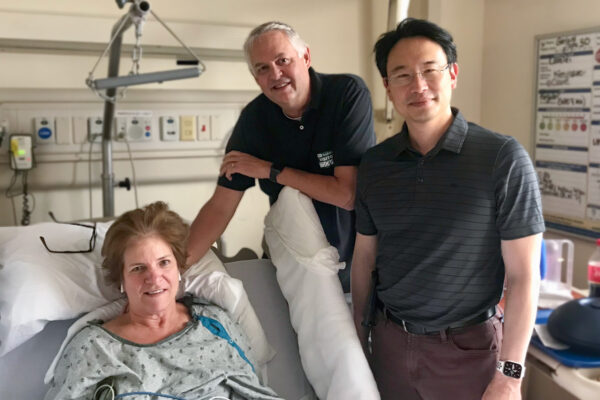
A WashU Medicine-led clinical trial conducted at Siteman Cancer Center has found that a personalized vaccine to treat glioblastoma appears to increase recurrence-free survival in a subset of patients after surgery. Trial participant Kim Garland (left) has had no recurrence of her tumor in the nearly five years since her surgery, which was performed by Albert Kim, MD, PhD (right), the August A. Busch, Jr. Professor of Neurological Surgery at WashU Medicine. Kim’s husband Scott Garland pictured in middle.
Kim Garland is a retired school nurse who lives in Kirkwood, Missouri, with Scott, her husband of 31 years. In June 2021, at age 62, Kim was volunteering at a youth camp in Ironton, Missouri, when her daughter-in-law, also volunteering at the same camp, noticed that Kim was struggling with confusion and forgetfulness, as well as headaches that would come and go throughout the day.
“I was forgetting things, things that should have been very obvious,” said Kim.
A scan at a local hospital’s emergency room back in St. Louis revealed a 6.5-centimeter mass in Kim’s brain — about the size of a small avocado. Within the week, Albert Kim, MD, PhD, the August A. Busch, Jr. Professor of Neurological Surgery at WashU Medicine, director of The Brain Tumor Center at Siteman, and co-author of the study, performed the initial surgery to remove her tumor. The grim diagnosis of grade 4 glioblastoma came after the tumor was removed.
When offered the opportunity to participate in a clinical trial, Kim Garland agreed in hopes that her participation would improve future treatments. After receiving this prognosis, both Kim and Scott did not expect that she would be alive with no recurrence nearly five years after her initial diagnosis.
“We know we are fortunate to have the kind of care that Kim has been able to receive, just a 30-minute drive from our home,” Scott said. “We see many other patients who are traveling long distances for their treatments. Having this level of care and treatment so close to home has been a huge blessing.”
With the support of their team, the couple have gained the confidence to make longer-term plans, including a long-delayed vacation this summer and spending quality time with their children and 15 grandchildren — a big change from the week-by-week life they were living in the aftermath of Kim’s initial diagnosis.
“Cancer vaccines have a long history, and the development of personalized neoantigen-targeting therapeutic vaccines now represents a highly compelling approach in glioblastoma and in other cancers,” said co-senior author Gavin Dunn, MD, PhD, a neurosurgical oncologist at Mass General Brigham Cancer Institute. “These programs require a high degree of integrated teamwork, and we are fortunate to have collaborated with many dedicated team members in this effort.”
Kim Garland’s cancer, along with those of the other patients in the trial, was an unmethylated MGMT subtype of glioblastoma, which is particularly hard to treat because it is not responsive to available treatment options such as chemotherapy. Johanns said the next step is to assess the vaccine’s efficacy in a larger group of patients, and to expand the treatment to all types of glioblastomas. The goal of Johanns and his team is to improve the vaccine response to ensure that more patients can experience benefits like those experienced by Kim Garland.
The knowledge that their participation in the trial has potentially advanced care is a comfort to the Garlands, who still need to steel themselves before each follow-up appointment, out of concern that Kim’s tumor could yet return.
“What we’re hopeful for is that through research like this, someday, when another person hears the words ‘you have glioblastoma’ as their diagnosis, it will not cause as much anxiety,” said Scott. “Maybe, they will be told ‘this is the cancer you have, but it is very treatable.’ We are fortunate and blessed to be at the right place and at the right time, to be part of this clinical trial and have a small part in the battle against this terrible disease.”
# # #
Garfinkle EAR, Perales-Linares R, Gimple RC, Livingstone AJ, Kaleigh F. Roberts KF, Butt OH, Goedegebuure. SP, McLellan MD, Chang GS, Hundal J, Yan J, Navarro JB, Paxton SA, Chattopadhyay S, Cooch N, Perales-Puchalt A, Stavroulaki K, Rochestie S, Peters J, Junker B, Campian JL, Chheda MG, Chicoine MR, Kim AH, Willie JT, Zipfel GJ, Dowling JL, Miller CA, Griffith OL, Griffith M, Gillanders WE, Miller, KE, Mardis ER, Sardesai NY, Dunn GP, Johanns TM. Adjuvant personalized multivalent neoantigen DNA vaccination induces tumor-specific immune responses in newly diagnosed glioblastoma patients. Nature Cancer. May 12, 2026. DOI: 10.1038/s43018-026-01163-w
Funding for this study came from the Mark Foundation for Cancer Research Momentum Fellowship, National Institutes of Health (NIH) National Institute of Neurological Disorders and Stroke (NINDS) grants R01NS117149 and R01 NS107833, the Nationwide Foundation Pediatric Innovation Fund, NIH K12CA167540 and The Alvin J. Siteman Cancer Center Investment Program along with The Foundation for Barnes-Jewish Hospital, NIH NINDS R01NS112712 and The Schnuck Family Fund and The Knight and Christopher Davidson Family Fund. Additional study support for development, manufacture, and administration of the treatment and monitoring of the immune responses was provided by Geneos Therapeutics. The content is solely the responsibility of the authors and does not necessarily represent the official views of the NIH.
R.P.L., J.Y., N.C., A.P.P., S.R., J.P., and N.Y.S are either current or previous Geneos Therapeutics employees.
AIMBE represents accomplished individuals in the fields of medical and biological engineering and brings together academia, industry, government and scientific societies to provide leadership and advocacy in medical and biological engineering for the benefit of society.
Chen, who also is a professor of biomedical engineering at WashU McKelvey Engineering and of neurosurgery at WashU Medicine, was nominated, reviewed and elected by peers and members of the AIMBE College of Fellows. They noted her “innovations in noninvasive focused ultrasound techniques to revolutionize brain disease diagnosis, therapy and fundamental understanding of brain function.”
Chen has been at the forefront of the field of NeuroSonics, pioneering the integration of neuroscience, ultrasound engineering and translational medicine to develop noninvasive technologies for brain cancer diagnosis and therapy. Her research has advanced ultrasound-enabled, image-guided platforms for targeted drug delivery and liquid biopsy of brain tumors. Chen’s work spans the full innovation pipeline, from basic mechanistic studies and medical device development to first-in-human clinical studies and commercialization.
Election to the AIMBE College of Fellows is highly competitive; membership is composed of the top 2% of engineers in medicine and biology who have made outstanding contributions to their fields.
Most of us don’t think too much about the liver. And that’s normal. Hearts and lungs seem to get many more health headlines and social media posts. But like all organs, the liver quietly does really important work. Among other jobs, it clears toxins from the body, stores energy and helps with immunity.
So, there are a lot of great reasons for us to take steps to improve our liver health. And none is bigger than helping lower the risk of liver cancer.
“Liver cancer doesn’t get as much attention as some other cancers, but it’s serious,” said Yikyung Park, a cancer researcher and professor in the Division of Public Health Sciences at WashU Medicine. “Although it’s not one of the most common cancers, it is a leading cause of death from cancer — ranked 5th in men and 7th in women.”
Key causes of liver cancer include heavy alcohol drinking, infection with the viruses hepatitis B or hepatitis C, and scarring of the liver, called cirrhosis. Smoking, obesity, diabetes and a condition called fatty liver disease also increase risk. And many of these factors can overlap with each other.
The good news?
“Liver cancer is preventable,” Park added. “Reducing risk factors and getting regular medical care are important, especially for people who know they already have some type of liver disease.”
Work on boosting your liver health with these steps:
Get a screening test for hepatitis B and hepatitis C. Infection with these viruses can damage the liver and increase the risk for cancer. And most people who have them may feel normal and not know anything is wrong. Hepatitis C can be treated, and therapies can limit damage from hepatitis B, so it’s recommended that all adults get a simple blood test for each. It’s usually just a one-time appointment. Ask your doctor or clinic about it.
Get vaccinated for hepatitis B. This is a very safe and effective way to prevent infection with hepatitis B. While most adults in the U.S. have been vaccinated, many have not. So, ask your doctor if you should get the vaccine, and encourage the new parents and expectant parents in your life to follow guidelines and protect their children with the vaccine as well.
Limit alcohol — zero is best. Limiting how much we drink is an important way to lower the risk of liver diseases and liver cancer. And with the many other risks from moderate — and even light — drinking, not drinking is the healthiest choice overall.
Maintain a healthier weight — focus on healthy eating and physical activity. Weight gain and obesity increase the risk of a condition called fatty liver disease, which is an increasingly common cause of liver cancer in the U.S. Being physically active and eating a healthy diet rich in fruits, vegetables and whole grains can help keep weight in check. Together, they can also help lower the risk of diabetes — another risk factor for liver cancer. If you’re looking for help with your weight, talk to your doctor or health clinic for advice.
Don’t smoke — get help quitting if you do. Liver cancer is one of the many cancers caused by smoking. If you don’t smoke, be sure to stay smoke-free. If you do smoke, try to quit. You can do it. Smokefree.gov and 1-800-QUIT-NOW have many free tools that can help.
If you have liver disease, see a doctor regularly. Keeping up with medical care for your liver disease is very important. It can help lower the risk of developing cancer — and if cancer does happen to develop, it can help find it earlier when it’s more treatable.
A recent international report in The Lancet highlighted the power that prevention can have, estimating that 60% of liver cancers across the globe could be avoided with steps most of us could take.
Park concluded by saying that while some people think that only heavy drinkers get liver cancer, drinking is just one of many important behaviors that impact risk for the disease:
“Simple actions can have real benefits. Knowing hepatitis B and hepatitis C status and making lifestyle changes — like not smoking, eating a healthy diet and getting to a healthier weight — can lower the risk of liver disease — and the risk of liver cancer.”
The ASCI focuses on the special role of physician-scientists in research, clinical care and medical education, as well as their leadership in academic medicine and industry.
Founded in 1908, the ASCI recognizes early- to mid-career physician scientists who have made significant contributions to translational or clinical research. Election is a recognition of outstanding scholarly achievement and impactful, sustained work that advances the understanding, diagnosis or treatment of human disease.
Puram has advanced scientists’ understanding of tumor growth, treatment resistance and metastasis in head and neck cancers — discoveries that have opened new options for treating these challenging tumors. His research explores the complex ecosystem of diverse cells within a tumor and how they communicate with one another, using single-cell and spatial analyses to understand tumors in exquisite detail. His work has helped define the cellular and molecular diversity within head and neck cancers, informed several innovative clinical trials and identified potential therapeutic targets to improve patient outcomes.
He was one of three WashU Medicine physicians elected to the society this year. The others are Suzanne E. Schindler, MD, PhD, an associate professor of neurology, and Christopher D. Smyser, MD, the A. Ernest & Jane G. Stein Professor of Developmental Neurology and chief of the Division of Pediatric & Developmental Neurology.
Their election to ASCI highlights WashU Medicine’s strength in supporting physician-scientists who bridge laboratory research and clinical care. Puram, Schindler and Smyser were formally inducted at the 2026 annual joint meeting of the ASCI, the Association of American Physicians and the American Physician Scientists Association in Chicago.
The endowed chair was made possible by donors, many of whom have been patients of Margenthaler at Siteman Cancer Center, based at Barnes-Jewish Hospital and WashU Medicine.
“It’s about how many patients she took care of and how many patients she helped and how many patients she cured,” Siteman Cancer Center Director Timothy J. Eberlein, MD, a breast surgeon himself, said during the installation ceremony. “I don’t think there is a better person who could be better feted with this endowed chair than Julie Margenthaler because, as many of you in the audience will attest, she is the most caring, compassionate but superb physician.”
Margenthaler has taken a holistic approach to patient outcomes that incorporates the three pillars of academic medicine: clinical care, research and educating the next generation of physician-researchers.
In the clinic, she is both a surgical oncologist and director of Breast Surgical Services at the Joanne Knight Breast Health Center at Siteman, which emphasizes screening and imaging excellence.
On the research side, Margenthaler’s interests include identifying minimally invasive approaches to breast cancer staging using imaging combined with molecular techniques. She also studies the identification of non-BRCA genes responsible for the development of breast cancer in young women under the age of 40, as well as the design of novel gene-specific approaches to breast cancer treatment.
“This endowed chair will allow us to continue to push the envelope in research for advances to come 10 or 20 years from now,” she said. “And it will allow us a regenerating mechanism for research, specifically research that may not be traditionally funded by the National Institutes of Health. It also creates a legacy that will allow us to recruit the best people who want to continue our mission.”
Pam Nicholson is one of Margenthaler’s patients whose generosity led to the creation of the Endowed Chair for Surgical Excellence in Breast Cancer.
“You’re in such a vulnerable position when you’re first diagnosed,” Nicholson said. “Dr. Margenthaler is just that right person who is so calming, and she instills confidence. Your doctor matters and where you go matters. I think Dr. Margenthaler is a jewel for the hospital, for St. Louis and for all the Midwest.”
Nationally, Margenthaler has served in many roles, as well, including as president of the American Society of Breast Surgeons. Currently, she is section editor for the Annals of Surgical Oncology and a member of the editorial board of the Journal of Surgical Research. She also reviews 12 other journals and is the author of more than 240 peer-reviewed publications, reviews, editorials and book chapters.
For the past decade, Margenthaler has been named a Castle Connolly Top Doctor, a recognition of excellence in clinical care, education and research for the top 7% of practicing U.S. physicians. She is board-certified by the American Board of Surgery and is a Fellow of the American College of Surgeons (FACS). She also is a specialist focused on early detection, genetic counseling and proactive management for women with an increased risk of breast cancer.
Read more about Margenthaler’s path to becoming a physician, and her impact. Watch video of her chair installation.
Davidson, who has been chief of Gastroenterology since he joined the WashU Medicine faculty in 1998, is a leading expert on hereditary and familial gastrointestinal cancers. At Siteman Cancer Center, he also is a research collaborator in the Hereditary GI Cancer Program.
The AGA Distinguished Mentor Award recognizes individuals who have dedicated their careers to mentoring the next generation of leaders in gastroenterology. It is a noteworthy tribute to Davidson, who has consistently credited his own mentors who helped shaped his career.
“Mentorship has been one of the most rewarding threads running through my career,” he said. “When we invest in training the next generation of gastroenterologists and physician-scientists, our patients benefit longer-term from better science, better treatments and more compassionate, informed care.”
For almost three decades, Davidson has mentored more than 200 fellows, residents and medical undergraduates in the Division of Gastroenterology — many of whom have gone on to become prominent clinicians and physician-scientists, themselves. Several have served as division chiefs, program directors or department chairs.
Additionally, at WashU Medicine and Siteman, Davidson is director of the Silvio Conte Digestive Disease Research Core Center, which provides access to core services to complement research in digestive and liver disease. The core center is funded by a prestigious and longstanding federal P30 Center Core Grant.
In 2017, Davidson was recognized by the AGA as a Council Section Research Mentor for his record of outstanding research mentorship. Davidson also has directed several academic skills workshops for the association, extending the reach of his passion for mentoring.
Davidson’s own research focuses on the molecular genetics of lipid transport and intestinal lipid metabolism. He studies how the body handles fats in the gut and liver and how problems in that process can lead to fatty liver disease and some cancers. His published research offers groundbreaking insights into the epidemiology and risk factors of liver-related diseases and liver cancer.
Davidson earned his medical degree from King’s College Hospital Medical School in London and completed his gastroenterology fellowship at Columbia-Presbyterian Medical Center in New York. He was an academic researcher and faculty member of the University of Chicago for 12 years before being recruited to join WashU Medicine.
Foundation awards $1.5 million total in grants to WashU Medicine researchers at Siteman Cancer Center to advance precision diagnosis and treatment for patients with myelodysplastic syndromes
The Edward P. Evans Foundation has awarded separate three-year Discovery Research Grants to Jeremy Baeten, PhD, an assistant professor of medicine, and Matthew Walter, MD, the Edward P. Evans Endowed Professor of Myelodysplastic Syndromes, both in the Division of Oncology at WashU Medicine. Walter treats patients at Siteman Cancer Center, based at Barnes-Jewish Hospital and WashU Medicine. He and Baeten are research members at Siteman.
The awards, which total $1.5 million, represent an investment in research that is advancing the field of myelodysplastic syndromes (MDS), a group of blood cancers characterized by low blood cell counts.
Baeten aims to improve treatments for patients who have MDS with mutations in an important gene called TP53, which causes resistance to current therapies. Baeten will study how a new drug combination kills these cancer cells better than available drugs and how blocking another gene might make these treatments even more effective.
Walter will explore using whole-genome sequencing to monitor mutated blood cells in patients with MDS or clonal cytopenias of undetermined significance, a disease that predisposes patients to developing MDS, including tracking whether changes in mutations are linked to disease progression. The funding also will help advance his work in collaboration with Kelly Bolton, MD, PhD, an assistant professor of medicine in oncology and a Siteman research member, to examine how mutated cells respond to targeted treatments, which could help guide more personalized treatment choices.
The Edward P. Evans Foundation previously provided grant funding to WashU Medicine, including support for Baeten and Walter. In 2019, the foundation established the Edward P. Evans Center for Myelodysplastic Syndromes at WashU Medicine, one of four MDS-supported centers nationally. The foundation also funded the endowed professorship that Walter holds.
With the prestigious award, Yin Cao, ScD, MPH, will write a book examining why cancers are increasingly occurring earlier in life — and how this shift can be better understood, communicated and prevented.
Selected from nearly 5,000 applicants as part of the foundation’s 101st class of fellows, Cao is recognized for her leadership in integrating data science, cancer etiology and population health. She is a molecular epidemiologist and an associate professor of surgery and of medicine in the Public Health Sciences Division at WashU Medicine and a research member of Siteman Cancer Center, based at Barnes-Jewish Hospital and WashU Medicine.
This year’s class of 223 distinguished honorees work across 55 disciplines, each awardee selected based on past career achievements and exceptional promise. Cao is one of only two fellows recognized in data science.
“Our new class of Guggenheim Fellows is representative of the world’s best thinkers, innovators and creators in art, science and scholarship,” said Edward Hirsch, award-winning poet and president of the Guggenheim Foundation. “As the foundation enters its second century and looks to the future, I feel confident that this new class of 223 individuals will do bold and inspiring work, undaunted by the challenges ahead. We are honored to support their visionary contributions.”
Cao leads a research program focused on one of the most urgent questions in modern health: why cancers are rising among younger adults. Anchored in a multidimensional lens spanning exposures, tissues, life stages and populations, her group integrates epidemiologic and biological insights, empowered by data science, to uncover life course risk factors that contribute to cancer risk and tumor progression in younger generations
In recent work, Cao has highlighted the need to transform how cancer risk factors are discovered for prevention. In a perspective in Cell, she and colleagues proposed new interdisciplinary frameworks to accelerate the discovery of cancer causes in the era of rising early-onset cancers. These frameworks for integrating population research, mechanistic biology and data science to understand how exposures accumulate over time, interact across biological systems and shape disease risk long before diagnosis.
“I am deeply honored to receive this Guggenheim Fellowship,” Cao said. “It provides the rare space to think more deeply and creatively about what is needed for the community and to tell a bigger, more connected story — one that brings together science, patients and the public. Our goal is not only to understand why cancer is rising, but to change its trajectory, so fewer young people develop cancer and more are diagnosed earlier and live longer, healthier lives. We cannot achieve this alone, and progress will depend on working together across disciplines and communities.”
Building on years of work she has led to uncover the causes of early-onset colorectal cancer and advance earlier diagnosis in younger populations, Cao now leads a $25 million international initiative through Cancer Grand Challenges, a global team science initiative co-founded by Cancer Research UK and the National Cancer Institute (NCI), part of the National Institutes of Health (NIH). With support from the Guggenheim Fellowship, her work will bring this urgent scientific question into a broader public conversation — providing clear, evidence-based understanding to patients, families and communities, helping to strengthen public trust and highlighting prevention as an increasingly important priority for younger generations.