
Education in Cancer Imaging and Therapy (EduCaIT) Program
Mallinckrodt Institute of Radiology (MIR) and the Oncologic Imaging Program (OIP) of the Siteman Cancer Center established the Interdisciplinary Education in Cancer Imaging and Therapy (EduCaIT) Training Program to train the next generation of cancer researchers who will develop innovative diagnostic, prognostic, and therapeutic strategies to advance the management of patients with cancer. Cancer imaging and image-guided therapy is entering a transformative, interdisciplinary phase spanning chemistry, medical physics, computational biology, computational imaging, data science, and cancer biology, and there is currently insufficient STEM training to keep pace with these advances. To meet this need, EduCaIT provides interdisciplinary didactic and practical training in three tracks to pre- and postdoctoral investigators, guided by Program Faculty spanning the Schools of Medicine, Engineering, and Arts & Sciences.
Applications for pre- and postdoctoral trainees are currently open until Tuesday, September 8, 2026 at 11:59 PM CST.
EduCaIT Program Tracks
The Interdisciplinary Education in Cancer Imaging and Therapy (EduCaIT) Program provides interdisciplinary didactic and practical training in three tracks, which align with the research and training activities of Siteman’s Oncologic Imaging Program. The EduCaIT Program’s tracks include:
1. Molecular and Functional Imaging of Cancer
Master skills to develop and evaluate molecular and functional imaging agents to visualize, quantify, and target cancer biology.
2. Theranostics
Develop and apply principles of image-guided therapeutics, quantitative absorbed dose methodologies (dosimetry), and data science to enable optimized treatment regimens and efficient monitoring of disease.
3. Predictive Oncology
Learn to integrate patient- and tumor-specific data, including imaging features, multi-OMICS, spatial biology and multiplexed imaging, pathology, and liquid biopsies through artificial intelligence (AI) and biomathematical modeling frameworks to support precision oncology.
Eligibility
- Typically apply in their 2nd or 3rd year of graduate study (School of Medicine/DBBS, School of Engineering, or School of Arts & Sciences). We will consider exceptionally qualified 1st year applicants who have demonstrated experience in cancer research, ideally publications (including in preparation), strong academic credentials, and strong leadership experience.
- Do not have a citizenship requirement.
- May not be simultaneously supported by an NIH or other federal grant during the program
- Must be working or planning to work on a cancer-focused research project with an approved mentor
- All mentors must have an R01 grant or equivalent award and a strong mentorship record
- Click HERE for a list of approved mentors
- To propose your mentor be added to the program, email XXXX.
- Apply with no more than three total years of postdoctoral experience, whether accrued at Washington University or elsewhere.
- Be a US citizen, permanent resident, or non-citizen national
- May not be simultaneously supported by an NIH or other federal grant during the program
- Must be working or planning to work on a cancer-focused research project with an approved mentor
- All mentors must have an R01 grant or equivalent award and a strong mentorship record
- Click HERE for a list of approved mentors
- To propose your mentor be added to the program, email XXXX.
Application Instructions
The EduCAIT Program is currently accepting predoctoral and postdoctoral applications until Tuesday, September 8, 2026 at 11:59 PM CST. All letters and supporting documents must be submitted prior to the deadline.
Applicants may access the online application form HERE.
Please note: Once you enter an email address for one of your references, it will send an automated email requesting a letter of support from them.
The following documents must be uploaded as part of your online application:
- Curriculum Vitae
- Personal Statement (including leadership statement)
- Statement of Past Research Experience (no more than one page)
- Statement of Research Interest and desired EduCAIT Training Program Research Track
- Predocs must have two letters of recommendation. The first letter should come from the applicant’s proposed mentor, if one is already identified.
- Postdocs must have three letters of recommendation. One letter must be from your current mentor and two additional letters from other faculty at Washington University or from the University where you earned your PhD.
EduCaIT Program Directors
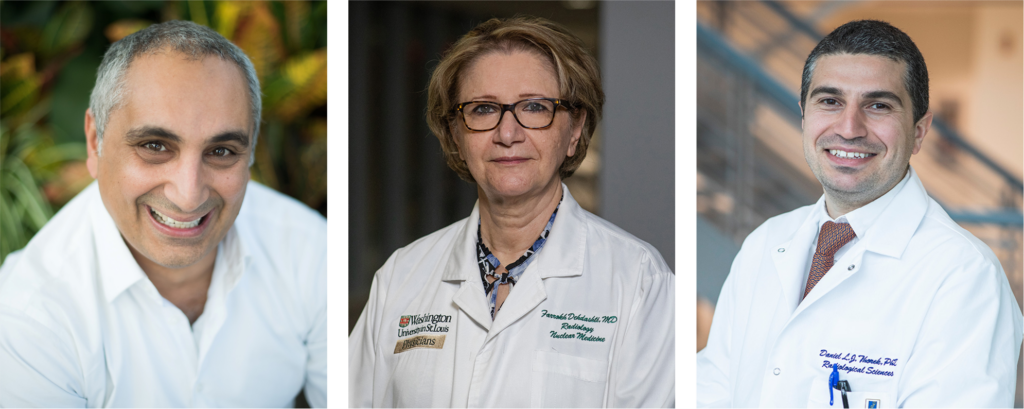
Kooresh Shoghi, PhD, Farrokh Dehdashti, MD, Dan Thorek, PhD
EduCaIT Program Requirements
Common to every track, all trainees complete:
- Principles and Applications in Biological Imaging (PABI, BIOL 5146)
- Cancer Biology (BIOL 4715/5715), or advanced topics if equivalent coursework was already completed
- Practical Bioinformatics (BIOL 4220)
- Translation Investigations (human research)/imaging Workshop
- Data/Imaging Science Bootcamp
- Grant Writing Workshop/Career Development
- EduCAIT Seminar Series
- Entrepreneurship and technology management
- Research Reproducibility and Rigor (R3)
- Responsible Conduct of Research (RCR)
Postdoctoral trainees complete the core curriculum courses relevant to filling gaps in their background; a course already completed (or its equivalent) may be waived with Mentoring Committee approval. Postdoctoral trainees are not required to complete track-specific curriculum but participate in all core and enrichment activities, with optional additional didactic training arranged through their Mentoring Committee.
Note: The scheduling/availability of the workshops, seminar series, and bootcamp is underway. The EduCAIT T32 will synergize with current offerings through the SCC, MIR, and WashU.
In addition to the core curriculum, predoctoral trainees complete three track-specific courses selected in consultation with their Mentoring Committee:
- Molecular and Functional Imaging of Cancer: Contrast Agents for Biological Imaging (CHEM 5147) is required, plus two electives.
- Theranostics: Radiological Physics and Dosimetry (MP 505) is required for the radiotheranostics sub-track, plus two of several options (e.g., Nuclear and Radiochemistry Laboratory, Radiation Oncology Physics, Contrast Agents for Biological Imaging); trainees pursuing theranostics broadly take CHEM 5147 plus two additional courses.
- Predictive Oncology: three elective courses selected to complement the trainee’s interest (e.g., machine learning and AI courses for Imaging Science trainees; imaging science courses for Computer Science/Engineering trainees; applied math courses).
All trainees participate in Program community and dissemination activities, including the Annual OIP Symposium, Annual MIR Symposium, and Annual SCC Research Symposium (each with dedicated trainee presentation/poster sessions), the Annual Imaging Science Pathway Retreat, and team-building events such as Siteman @ Cardinals and Pedal the Cause.
Trainees maintain an Individual Development Plan (IDP) with concrete milestones, tracked through myIDP.
Trainees are required to complete periodic evaluations that inform their own progress and the Program’s continuous improvement:
- Mentor-Mentee Survey—annually, with the first survey at six months into the appointment
- Program Satisfaction Survey—annually, at the end of each grant year
- Research Appraisal Inventory (RAI)—at entry and annually thereafter
- Each trainee is guided by two co-mentors from distinct domains (imaging/technology and cancer biology/clinical); mentors coordinate to align research direction, course selection, and progress review.
- Primary mentors are expected to have independent, well-funded research programs (generally R01-equivalent or higher) and a demonstrated mentorship track record.
- Junior faculty without R01-equivalent funding, or established investigators with a funding lapse, may serve as secondary mentors and can transition to primary status once R01-level funding and Mentoring requirements are met.
- Program Faculty composition is not fixed—the EduCAIT Advisory Committee reviews the roster annually and may add or remove faculty who no longer meet these criteria.
- Mentors must complete a recognized mentor training program before being added to the Program Faculty—the Faculty Mentoring Intensive through the Office of the Provost/CIMER (Center for the Improvement of Mentored Experiences in Research), or the equivalent program through the Center for Teaching and Learning (CTL) for Engineering and Arts & Sciences faculty.